Lecture Notes (Diploma) Lesson Plan
DEPARTMENT OF MECHANICAL ENGINEERING
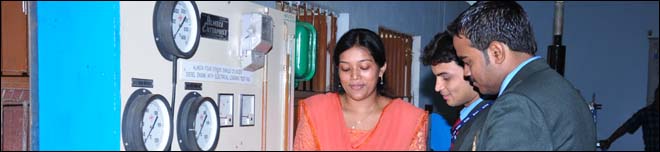
The Track of Machinery, Automobile and industry invites skilled engineers to these challenging fields to apply their skills and this promoted us to launch the branches of Mechanical Engineering. The Mechanical Engineering Department has got advanced laboratories in Thermal engineering, Production technology, Machine shop, Fluid mechanics, Hydraulic machines, Material testing, Metallurgy, Heat transfer, Applied mechanics and CAD/CAM. All the laboratories are well equipped with state-of-the-art equipment according to the syllabi of BPUT/ SCTE&VT.
Students are made to think practical and analytical while doing their practicals under the guidance of talented professionals. They are encouraged to attend National Level Technical Seminars and present papers.
The department has CAD/CAM Lab comprising 30 Core i3 systems with AutoCAD and AutoCAD inventory series.
There is a full fledged workshop, with different sections devoted to Smithy Carpentry, Welding, forging, Machine Turning etc. The machining sections have lathes of 10ft. 8ft, 6ft & 4ft bed length, a capstan Lathe of 1ft bed length, a Universal milling machine radial drilling machine of 1inch capacity and one drilling machine of half inch capacity.
VISION
To be a premier knowledge hub in mechanical engineering education, entrepreneurship, and industry engagement, producing skilled engineers ready to address industrial challenges.
MISSION
- M1: To impart strong fundamental and advanced knowledge in mechanical engineering through effective teaching–learning practices and modern pedagogical methods.
- M2: To promote innovation and entrepreneurship by encouraging creative thinking, problem-solving, and startup-oriented initiatives among students.
- M3: To strengthen industry engagement through internships, industrial training, consultancy, and collaborative projects to enhance practical skills.
- M4: To develop technically competent and ethical engineers with leadership qualities, professional integrity, and social responsibility.
- M5: To equip graduates with industry-relevant skills and adaptability to effectively address real-world engineering challenges.
Program Educational Objectives (PEOs)
PEO1: To impart science-based engineering education to develop professional skills that will prepare the students for immediate employment in relevant branch of mechanical engineering in industry.
PEO2: To develop human potential to its fullest extent so that intellectually capable and creatively gifted leaders can emerge in range of professions.
PEO3: To develop among students the awareness of and the competence to be savvy users of information technology.
PEO4: To Develop among students the ability to work with others, in professional and social settings.
PEO5: To develop a global view among students so that they can appreciate diversity in the world and in intellectual pursuits and the desire and ability to keep learning throughout life.
Program Specific Outcomes (PSOs)
PSO1: Apply the acquired knowledge in design, thermal, manufacturing and interdisciplinary areas for solving industry and socially relevant problems.
PSO2: To enhance the abilities of students by imparting knowledge in emerging technologies to make them confident mechanical Engineers.
PSO3: Provide socially responsible, eco—friendly broad base solution to mechanical Engineering related problems adopting professional ethics.
PROGRAM OUTCOME (POs)
- Basic and Discipline specific knowledge: Apply knowledge of basic mathematics, science and engineering fundamentals and engineering specialization to solve the engineering problems.
- Problem analysis: Identify and analyse well-defined engineering problems using codified standard methods.
- Design/ development of solutions: Design solutions for well-defined technical problems and assist with the design of systems components or processes to meet specified needs.
- Engineering Tools, Experimentation and Testing: Apply modern engineering tools and appropriate technique to conduct standard tests and measurements.
- Engineering practices for society, sustainability and environment: Apply appropriate technology in context of society, sustainability, environment and ethical practices.
- Project Management: Use engineering management principles individually, as a team member or a leader to manage projects and effectively communicate about well-defined engineering activities.
- Life-long learning: Ability to analyse individual needs and engage in updating in the context of technological changes.
|