Lecture Notes (Diploma) Lesson Plan
DEPARTMENT OF CIVIL ENGINEERING
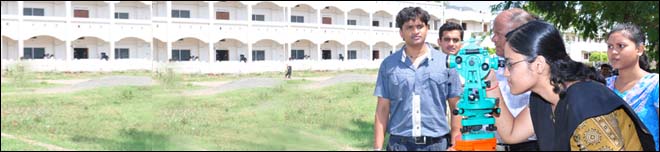
Being mother of all engineering branches, Civil Engineering has a significant
role in all round development of the Nation. In the Present age of fast technological growth, Civil
Engineers have to play a key role in providing appropriate infrastructure. National slogans as:
"Shelter for everyone", "Roads to every village", "Water to every field",
"Pollution free atmosphere" and "Jobs to every hand"
can only be fulfilled by skilled Civil Engineers by developing cost-effective,
eco-friendly, energy-intensive and innovative technology along with indigenous construction
materials using agro and industrial wastes.
The dept. offers strong foundation in the morals and applications of Civil Engineering, with the assistance of qualified & experienced faculties.
It has well equipped labs with following units-
- Transportation lab
- Material testing & Concrete lab
- CADD lab
- Soil testing lab
- Survey lab
- Construction Workshop Practice
- Public Health (PH) Engg. lab
- Hydraulics lab
VISION
To emerge as a center of excellence in civil engineering education, delivering globally relevant knowledge and
developing ethically strong engineers dedicated to building the nation.
MISSION
- M1: To provide strong foundational and advanced knowledge in civil engineering and technology through effective teaching learning processes.
- M2: To inculcate ethical values and professional responsibility among students to develop socially responsible engineers.
- M3: To promote practical learning and industry interaction through fieldwork, internships, and real-world projects.
- M4: To encourage innovation, research, and sustainable engineering practices addressing global and societal needs.
- M5: To prepare competent civil engineers capable of contributing effectively to infrastructure development and national growth.
Program Educational Objectives (PEOs)
PEO1: To impart science-based engineering education to develop professional skills that will prepare the students for immediate employment in relevant branch of civil engineering in industry.
PEO2: To develop human potential to its fullest extent so that intellectually capable and creatively gifted leaders can emerge in range of professions.
PEO3: To develops among students the awareness of and the competence to be savvy users of information technology.
PEO4: To develop among students the ability to work with others, in professional and social settings.
PEO5: To develop a global view among students so that they can appreciate diversity in the world and in intellectual pursuits and the desire and ability to keep learning throughout life.
Program Specific Outcomes (PSOs)
PSO1: Apply principles of mechanics and basic sciences to analyze civil engineering structures. Survey, map, measure and analyze data for sustainable infrastructure planning.
PSO2: Ability to enhance research skills and utilize advanced computing tools for analysis, design and implementation of these systems for resolving real life / social problems.
PSO3: To prepare plan, drawings, estimates, reports and execute all Civil Engineering projects by applying modern construction techniques, equipments and softwares which will equip them to complete the project in the stipulated time and cost.
PROGRAM OUTCOME (POs)
- Basic and Discipline specific knowledge: Apply knowledge of basic mathematics, science and engineering fundamentals and engineering specialization to solve the engineering problems.
- Problem analysis: Identify and analyse well-defined engineering problems using codified standard methods.
- Design/ development of solutions: Design solutions for well-defined technical problems and assist with the design of systems components or processes to meet specified needs.
- Engineering Tools, Experimentation and Testing: Apply modern engineering tools and appropriate technique to conduct standard tests and measurements.
- Engineering practices for society, sustainability and environment: Apply appropriate technology in context of society, sustainability, environment and ethical practices.
- Project Management: Use engineering management principles individually, as a team member or a leader to manage projects and effectively communicate about well-defined engineering activities.
- Life-long learning: Ability to analyse individual needs and engage in updating in the context of technological changes.
|